Download
Short History:
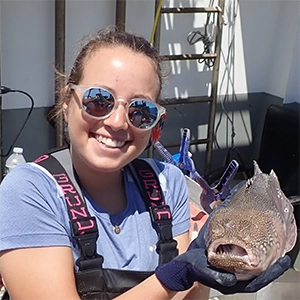
I grew up in Brooklyn, New York, and had the East River estuary system as my backyard which has inspired both my career path and my research interests. I attended Carleton College for my undergraduate education where I received a double Bachelor of Arts degree in Geology and Environmental Studies in 2022. I participated in a Marine Science NSF-REU at Rutgers in 2021 between my junior and senior years of college. My work during my REU exploring fundamental shelf processes in the Mid-Atlantic set the stage for my current research. After graduating from Carleton, I worked for the Rutgers University Haskin Shellfish Research Laboratory where I learned about fisheries science and the shellfish industry. Long story short, I fell in love with Rutgers and I never left! Outside of work, you can find me rock climbing, sitting in my hammock, playing with my cat Trudie or training for a triathlon.
Research Interests:
I am interested in the overlap between physical and biological oceanography although I approach my research from a physical perspective. I strive to connect my research with the broader communities impacted by my science. Specifically, my thesis work focuses on using observational data to understand the frequency and drivers of marine extreme temperature events in the Mid-Atlantic.