
About Ocean Gliders
The Slocum Glider Autonomous Underwater Vehicle (AUV), built by Teledyne Webb Research Corporation (Falmouth, MA), is an integrated instrument platform designed to operate in the ocean up to a 1000m depth. Its primary propulsion is via buoyancy changes driven by a ballast engine in the front of the vehicle. This allows the winged robot to descend and ascend at a specified glide angle achieving forward velocity. Steering is achieved via a rudder in the tail. Utilizing this efficient, but slow, method of locomotion allows gliders to have endurance measured in weeks or months instead of hours or days. This allows gliders, on a single battery charge, to travel upwards of 1000 km all whilst sampling the ocean around it.
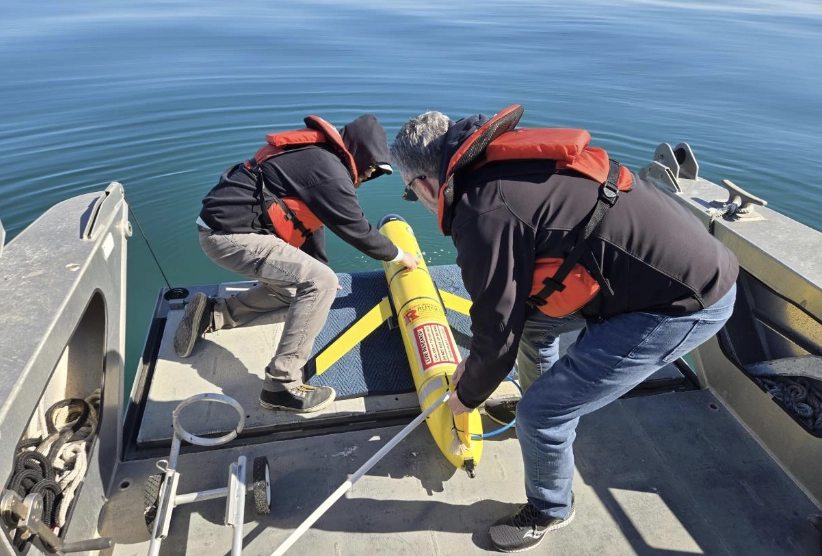
The result is an AUV with low energy and high endurance making it highly adaptable at ocean observing. Dedicated sections of the vehicle can be equipped with over 50 different sensors for scientific measurements. Whilst deployed, the robot communicates and uploads data via an Iridium satellite link allowing contact to operators and scientists around the globe.
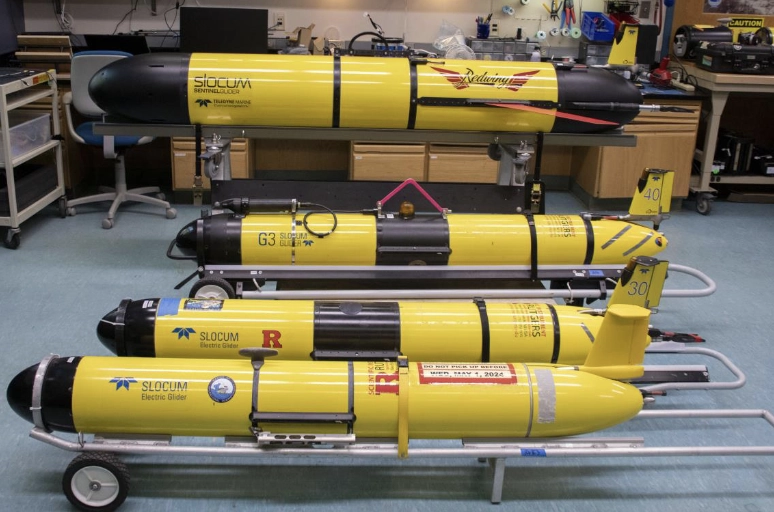
Whether the mission is a grad student research project, hurricane forecasting model feedback, or entire ocean spanning water sampling, the glider has become the instrument of choice for many ocean monitoring endeavors as it’s much less expensive to operate than ships. The live data is integral to research operations at RUCOOL and can include can include the following:
- temperature, salinity, and density
- absorption & scattering of light: chlorophyll levels, particle size, etc.
- photosynthetically available radiation (PAR)
- turbulence
- 3d currents
- oxygen
- nitrate
- pH (ocean acidity)
- passive acoustics (whale & spawning cod detection)
- fish/mammal tag detections
- active acoustics (zooplankton and fish detection)
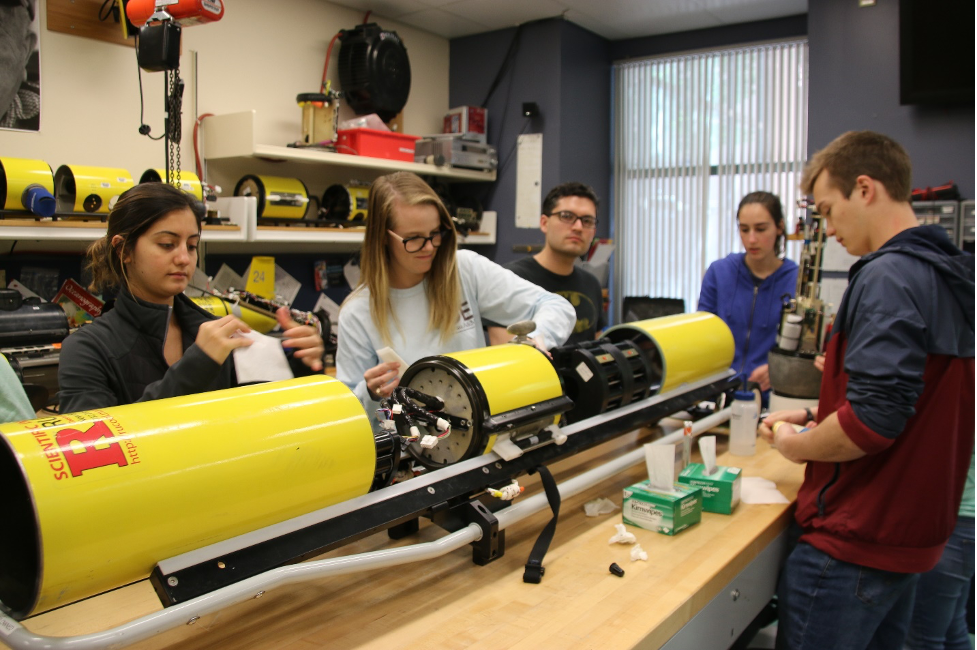
Rutgers deployed our first glider during the summer of 1998, and over two decades later, we have deployed gliders over 600 times across our planet in areas ranging from Svalbard to McMurdo Station, and from NJ to Sri Lanka. In 2009, Glider RU27 became the first robot to cross an ocean basin when it swam from NJ to Spain. Rutgers has remained at the forefront of the glider world, partnering on building the National Glider Data Assembly Center, hosting the 2019 EGO/UG2 international Underwater Glider meeting, and still remains a testbed for the newest state-of-the-art technology for new glider instrumentation, including integrating the first acoustic zooplankton sensor and pH sensor on a glider. Perhaps our best legacy is the many undergrad, graduate, and Navy students that have come through our doors to take our glider classes ranging from 1 week to semester long courses, and have gone on to become leaders in this industry throughout the US.
Links to More Glider Info
Gliders in Action
Glider II
OCOVI Gliders 2019
Challenger Mission Trailer: Indian Ocean Leg 1 Australia to Sri Lanka
Doug Webb on the Slocum Glider