
Background
The LEO-15 Testbed is a partnership between the New Jersey Economic Development Authority, Rutgers University, and Stockton University to support the advancement of the ocean engineering, construction, and energy sectors in NJ while providing workforce development in coastal sciences including the disciplines of marine technology, hydrography, and marine operations. Researchers and the future workforce will benefit from access to this offshore testbed to pilot and test new technologies, train undergraduate and graduate students, retrain and upgrade worker/laborer skills, and conduct ocean monitoring for a variety of stakeholders.
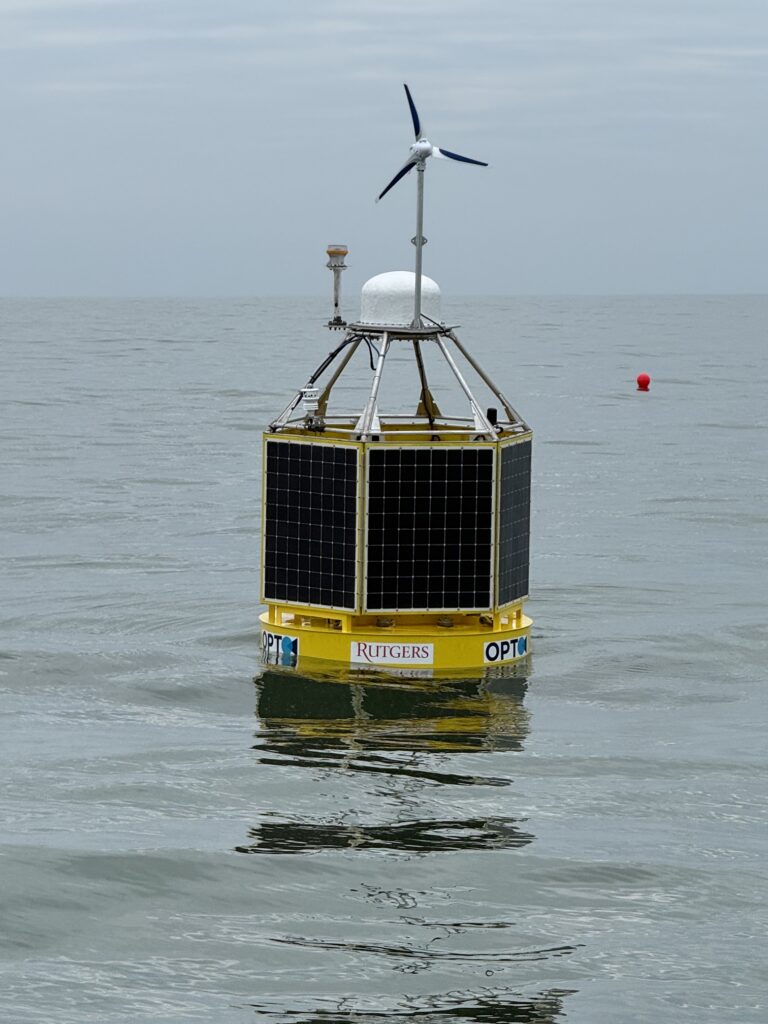
The Solar and Wind PowerBuoy® System from Ocean Power Technologies, deployed 3 miles offshore of the Rutgers Marine Field Station in Little Egg Harbor Township, New Jersey, provides a versatile, autonomous testbed to accelerate the development and validation of emerging marine technologies. Currently monitoring ocean temperature and salinity, tagged fish in the region, and standard meteorological variables, the mooring provides an opportunity to support a wide range of third-party payloads from stakeholders in the region.

About the LEO Legacy
The LEO-15 Testbed builds on the legacy of the original Long-Term Ecosystem Observatory (LEO), established in 1996 as one of the nation’s pioneering ocean observatories. LEO-15 delivered real-time data from cabled seafloor platforms and supported decades of research on storms, sediment transport, phytoplankton dynamics, and coastal change. Today’s testbed revives that legacy with a modern, renewable-powered platform, extending LEO’s role as a proving ground for coastal science and marine technology into a new era.
How the Testbed Works
The system draws on solar panels and small wind turbines allowing sensors to collect and transmit data continuously without reliance on the grid. This persistent, renewable power supply makes the buoy an effective host for third-party instruments: sensors can draw power and transmit data in real time, cutting the cost and complexity of independent offshore deployments.
Get Involved
Whether you’re a researcher looking to deploy a sensor, a company developing new ocean technology, or an educator interested in bringing students into the field, there are multiple ways to plug into the LEO-15 Testbed. We welcome inquiries about data access, payload integration, and collaborative research opportunities. Please fill out this contact form if you have any questions or would like to get involved.