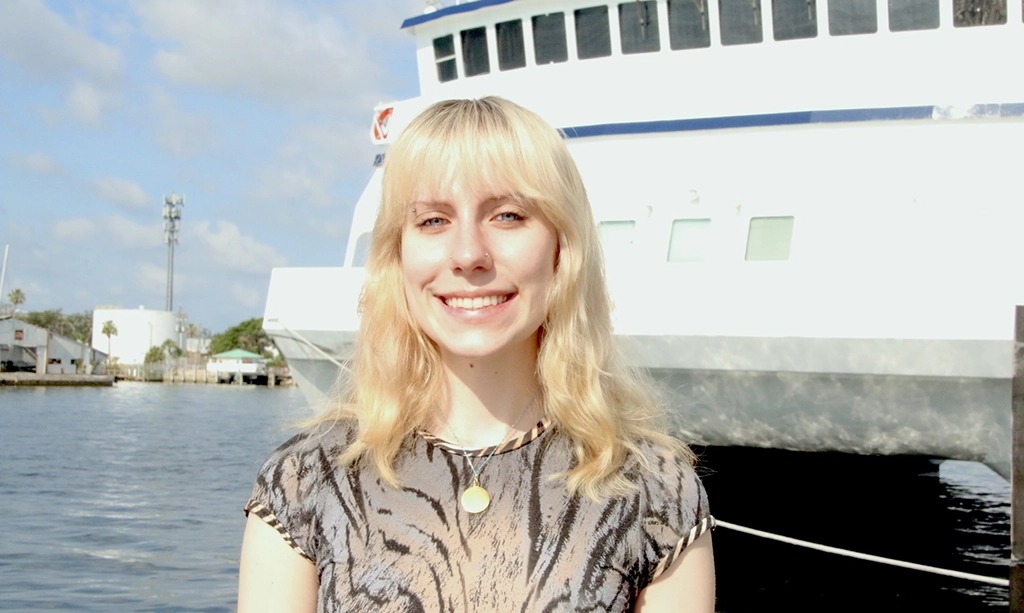
For students at the School of Environmental and Biological Sciences (SEBS), experiential learning is more than a graduation requirement. It is an opportunity to practically apply disciplinary knowledge, discover passions and build confidence to prepare for what comes next.
For Aishlin Ingraham, SEBS’26 marine sciences major with a physical oceanography option, that moment came in the form of a transformative summer research experience that helped shape her future as a scientist.
As Aishlin prepares to cross the stage in May 2026, she reflects proudly not only on the credits she’s earned and the challenges she’s overcome on the way to her degree, but also on the hands-on research experience she pursued during the summer of 2025. Encouraged by her advisors in the SEBS Educational Opportunity Fund (EOF) program, Aishlin applied for and was accepted into a highly competitive Research Experience for Undergraduates (REU), a paid summer research program funded by the National Science Foundation (NSF). The program covers housing, travel and a stipend, allowing students to fully immerse themselves in research alongside experienced scientists at host universities.
Aishlin participated in the Making Waves REU at the University of South Florida (USF) College of Marine Science, where she worked with Steven Meyers, chief scientist at the Ocean Center for Maritime and Port Studies, and Mark Luther, a physical oceanographer and associate professor. Her project focused on assessing the use of artificial intelligence to rapidly digitize historical tide gauge records from a defunct tide station in St. Petersburg, Florida.
Using an optical character recognition (OCR) platform called QDox, Aishlin and her collaborators achieved a transcription error rate of less than one percent—an encouraging result for the growing field of data archaeology. “Longer, digitized historical records are critical for performing more accurate analyses and future predictions of oceanographic conditions in a region,” Aishlin explains.
At the conclusion of the REU, Aishlin presented her findings in a research poster, an experience she describes as a privilege for an undergraduate student. Her work didn’t stop there. During the Spring 2026 semester, she continues to collaborate with Meyers, her mentor, who is helping her analyze the data and draft a manuscript for a potential research publication.
Beyond the research itself, Aishlin gained valuable professional experience through career development workshops, networking with program alumni, and hands-on ocean sampling during a day cruise aboard a research vessel. “The REU offered many great career-building workshops,” she says. “We also had the chance to network and practice real-world ocean sampling techniques.”
The experience confirmed Aishlin’s passion for research and clarified her long-term goals. “This experience was pivotal in advancing my career as a scientist,” she says. “I made a lot of great connections and realized that I would like to continue research and education in graduate school. It made me feel more confident in my abilities as a scientist.”
As she looks ahead to life after SEBS, Aishlin is considering graduate study in physical oceanography or data analysis, or a career as a data analyst. The skills and confidence she gained through experiential learning, she says, will continue to guide her path.
For Aishlin, experiential learning wasn’t just a summer opportunity. It was a defining step toward a future in science.
Original article at Rutgers NJAES Newsroom