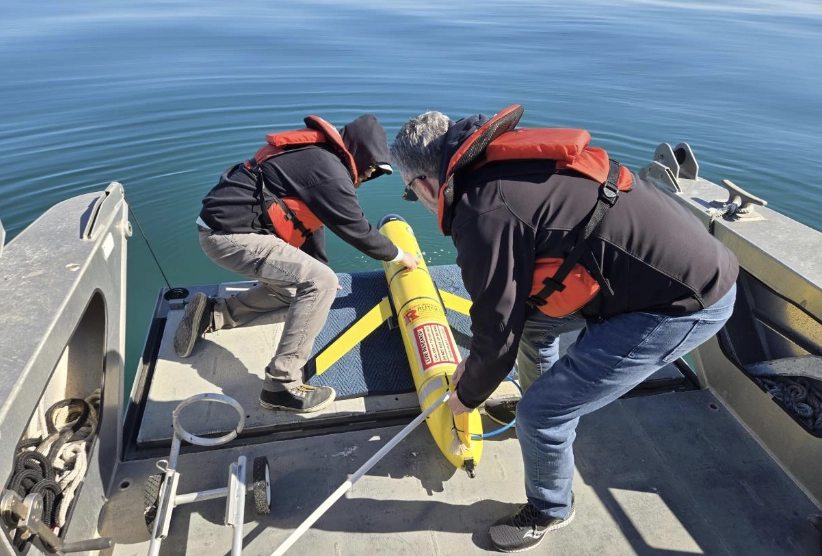
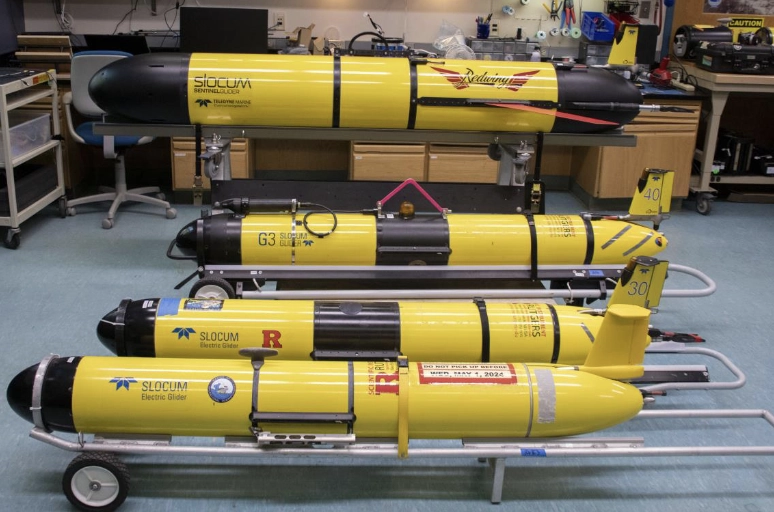
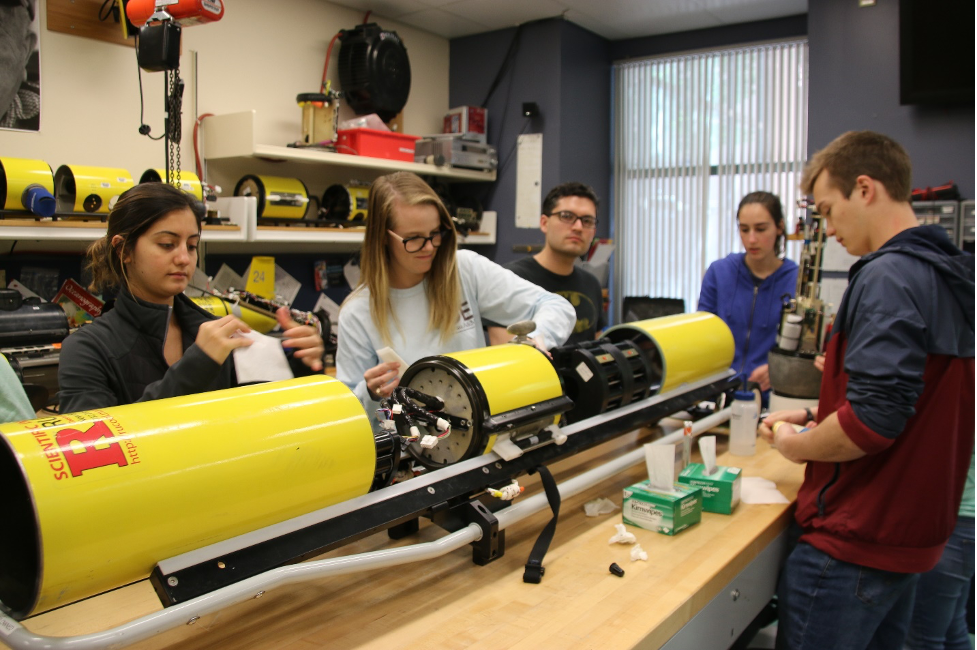
The Slocum Glider Autonomous Underwater Vehicle (AUV), built by Teledyne Webb Research Corporation (Falmouth, MA), is an integrated instrument platform designed to operate in the ocean up to a 1000m depth. Its primary propulsion is via buoyancy changes driven by a ballast engine in the front of the vehicle. This allows the winged robot to descend and ascend at a specified glide angle achieving forward velocity. Steering is achieved via a rudder in the tail. Utilizing this efficient, but slow, method of locomotion allows gliders to have endurance measured in weeks or months instead of hours or days. This allows gliders, on a single battery charge, to travel upwards of 1000 km all whilst sampling the ocean around it.
The result is an AUV with low energy and high endurance making it highly adaptable at ocean observing. Dedicated sections of the vehicle can be equipped with over 50 different sensors for scientific measurements. Whilst deployed, the robot communicates and uploads data via an Iridium satellite link allowing contact to operators and scientists around the globe.
Whether the mission is a grad student research project, hurricane forecasting model feedback, or entire ocean spanning water sampling, the glider has become the instrument of choice for many ocean monitoring endeavors as it’s much less expensive to operate than ships. The live data is integral to research operations at RUCOOL and can include can include the following
• temperature, salinity, and density • absorption & scattering of light: chlorophyll levels, particle size, etc. • photosynthetically available radiation (PAR) • turbulence • 3d currents • oxygen • nitrate • pH (ocean acidity) • passive acoustics (whale & spawning cod detection) • fish/mammal tag detections • active acoustics (zooplankton and fish detection)