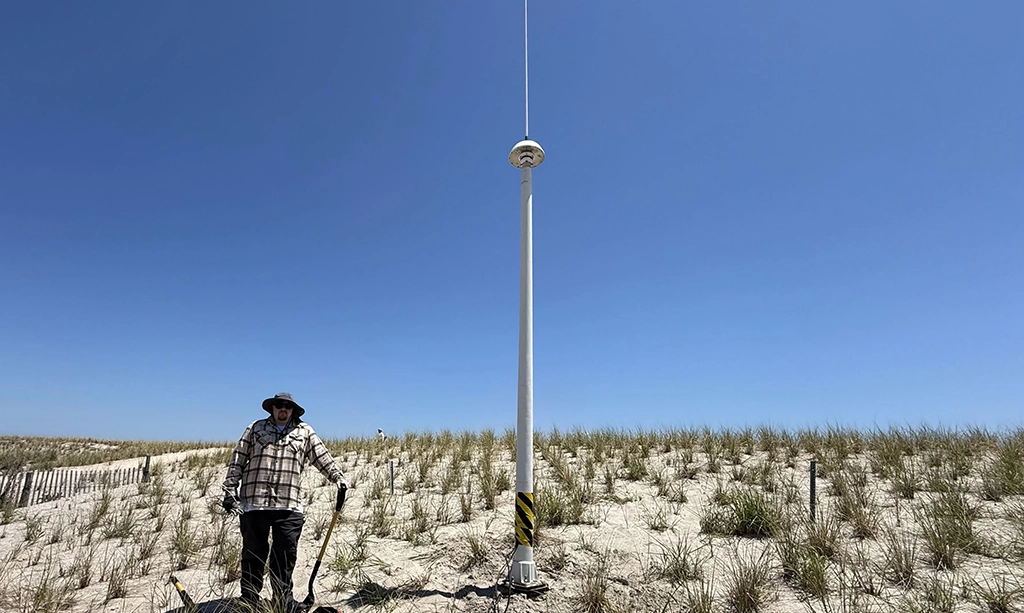
RUCOOL’s CODAR HF-Radar network, part of a large Mid Atlantic HF-Radar network supported by the Mid Atlantic Regional Association Coastal Ocean Observing System (MARACOOS), has been delivering surface current data to the US Coast Guard for Search and Rescue for 20 years. Recently the data quality received a significant boost.
CODAR’s Radial Suite Release 25 changed a lot about how radial data get processed, both before and after the fact. The big additions, from RUCODAR’s perspective, were on the quality-control (QC) side. R25 now automatically strips out outlier velocities, “lonely” vectors with few or no neighbors, and vectors flagged as being over land or outside the expected coverage area. It can also fill small gaps with distance-weighted interpolation from neighboring vectors, and those filled vectors stay flagged so measured data can still be told apart from estimated data. The part that affected the team most is what R25 does when it decides a site has a problem. If it sees too few vectors overall, or low-to-no echoes on one of the receive channels, it pulls that data out of processing entirely rather than passing could-be questionable radials downstream. The intent is good, but the effect was that a couple of sites that had been performing fine started coming up blank.
Lewes DE (LEWE) and Holgate NJ (HLGT) were the two sites that got caught. The team couldn’t just loosen the QC to make the problem go away, since several of those settings are tied directly to MUSIC, the algorithm that generates the radials in the first place. That left the other option: addressing what R25 was complaining about. In both cases it turned out to be the right call, and the data is cleaner for it.
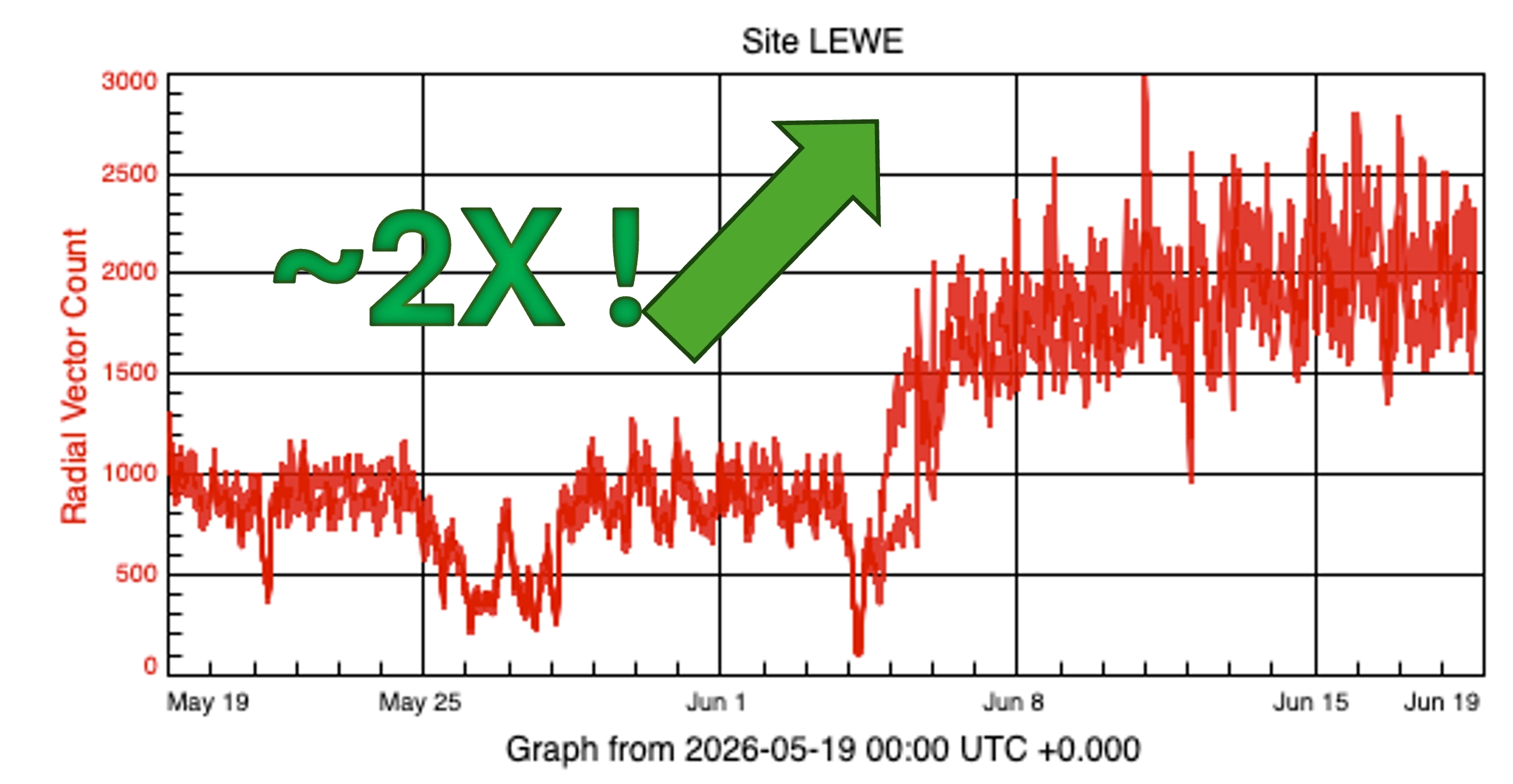
LEWE – Lewes, Delaware (owned by the University of Delaware): This group had previously had luck at other sites correcting a center frequency that had been set to another value from what the hardware was actually tuned to, so they tried the same thing here. Moving LEWE’s center frequency from 26.3 MHz down to 24.55 MHz nearly doubled the vectors in the radial field. With that much more signal to work with, the team was also able to push the site’s maximum range out, and LEWE now covers almost all of Delaware Bay.
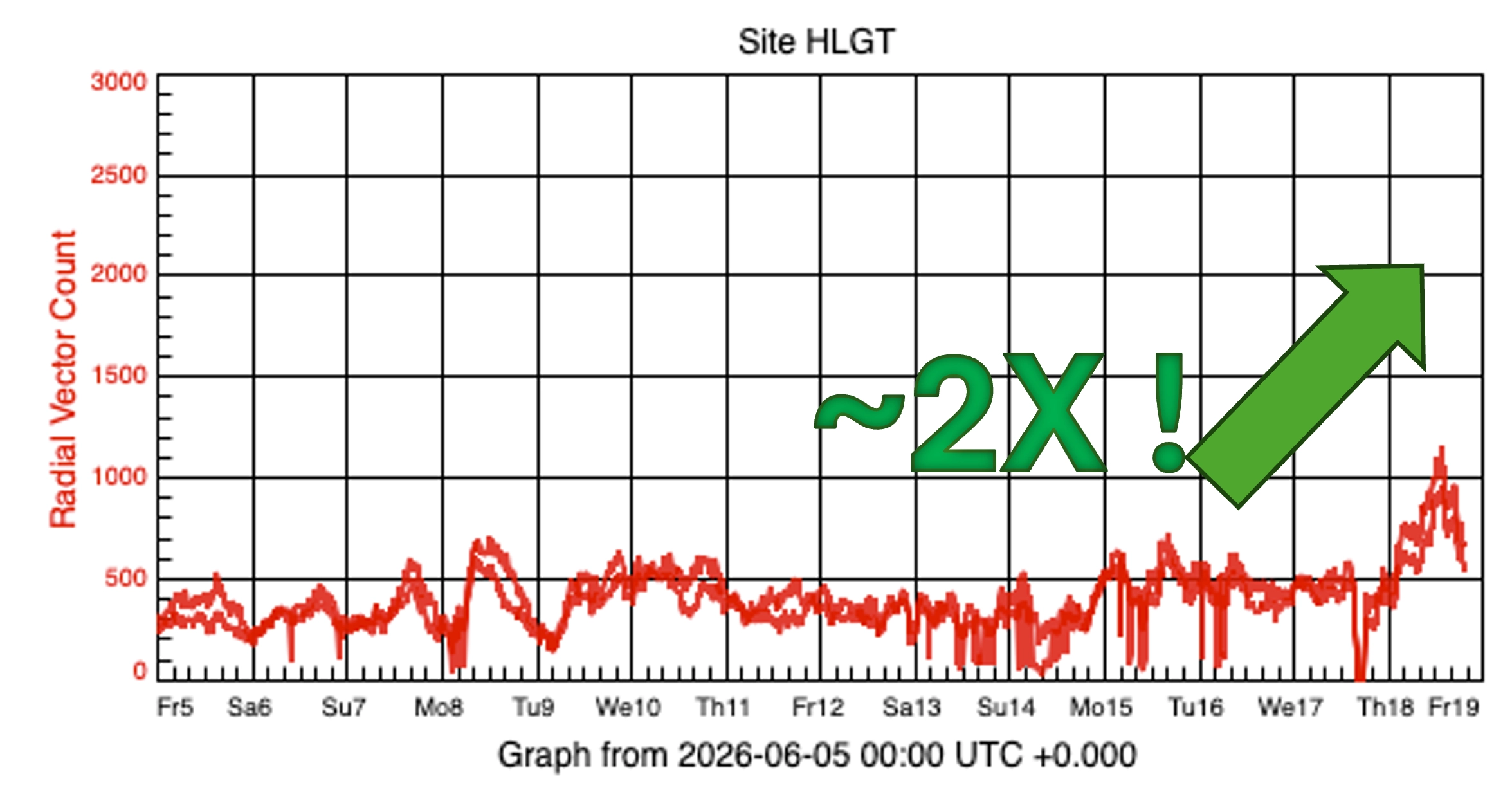
HLGT – Holgate, Long Beach Island: At HLGT the signal-to-noise on antenna Loop 1 was sitting well below Loop 3, the monopole, far enough that R25 was reading it as a bad receive channel and blanking the maps. It had been this way for a while after the team had to move the antenna closer to land due to dune replenishment. The site was still producing usable data, but losing maps that often pointed at a hardware problem. On Wednesday, June 17, the team went out to the site and swapped the TX/RX 13.475 MHz dome antenna for a freshly RMA’d unit. The original dome had some apparent damage up top, and it’s gone back for RMA.