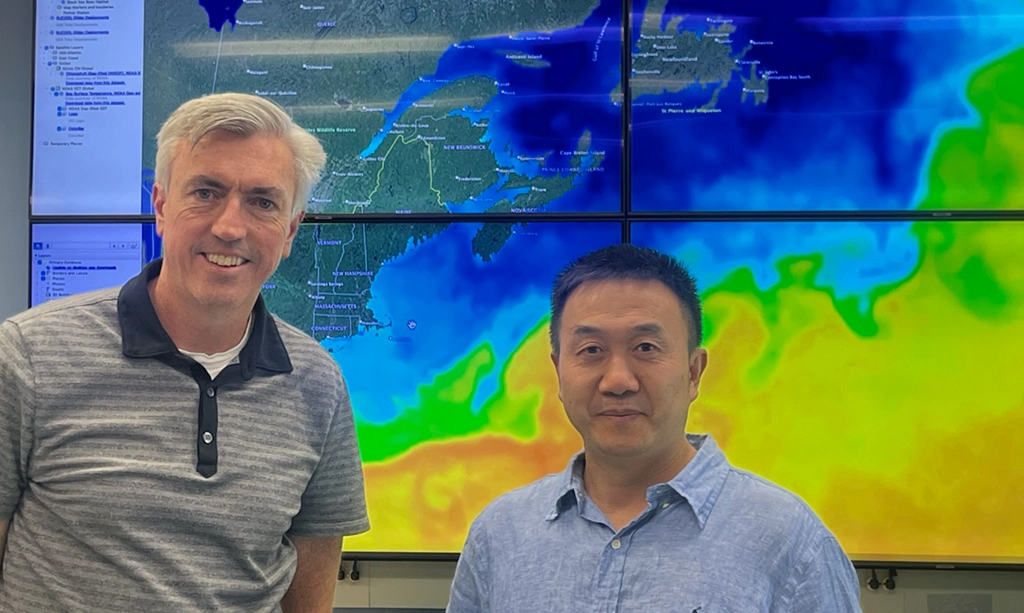
The ocean is constantly changing, and observing those changes across large areas requires increasingly diverse technologies. That challenge was the focus of a recent Rutgers University visit by Weimin Huang, professor of electrical and computer engineering at Memorial University of Newfoundland.
Huang’s research spans high-frequency (HF) radar, marine radar, synthetic aperture radar (SAR), and Global Navigation Satellite System reflectometry (GNSS-R). His visit provided an opportunity to connect these emerging technologies with Rutgers’ extensive experience in operational coastal HF radar.
Through funding from MARACOOS, Rutgers operates coastal HF radar systems that provide near-real-time measurements of surface currents across the Mid-Atlantic. These observations support ocean research as well as applications including maritime safety and search and rescue.
GNSS-R offers a fundamentally different approach. Instead of transmitting its own radar signal, receivers analyze navigation-satellite signals after they reflect from the Earth’s surface. Over the ocean, those reflections can provide information about waves and winds, while researchers are also exploring applications such as sea-ice monitoring.
Huang’s research highlights how these technologies can provide complementary views of the ocean. In August 2026, he made two oral presentations and one poster presentation on ocean remote sensing using radars at the IEEE International Geoscience and Remote Sensing Symposium (IGARSS 2026) in Washington DC. He was able to combine his trip to the IGARSS meeting with his visit to Rutgers.
For Rutgers, the discussion reflects a broader future for ocean observing: combining established systems such as HF radar with emerging remote-sensing technologies to obtain a more complete picture of a complex and changing ocean.